
Category
AC Installation & Replacement
Buying guides, cost breakdowns, and comparisons to help New Orleans homeowners choose the right new AC or full HVAC system.
Replacing an HVAC system in Southeast Louisiana is a different project than it is almost anywhere else. Sizing has to account for extreme latent load, ducts in hot attics or damp crawl spaces are frequently part of the job, and installation quality determines whether a high-efficiency system actually performs like one.

Sizing for Heat and Humidity, Not Just Square Footage
The most common installation mistake we see locally is oversizing. A system that is too large cools the air quickly, satisfies the thermostat, and shuts off before it has removed much moisture. The house ends up cold and clammy, the compressor short-cycles, and the equipment wears faster than it should.
Correct sizing comes from a load calculation that accounts for insulation levels, window area and orientation, air leakage, duct location and condition, and the very high latent load our dew points create. Rules of thumb based on square footage alone are how homes end up with an oversized system and a humidity complaint that no thermostat setting can fix.
Equipment staging matters too. Two-stage and variable-capacity systems run longer at lower output, which is exactly the behavior that dehumidifies well in this climate.
- A load calculation, not a square-footage rule of thumb
- Duct evaluation for sizing, sealing, and insulation before equipment selection
- Staged or variable-capacity equipment for better humidity control
- Correct line-set handling, evacuation, and verified charge at start-up
- Permits and inspection handled by the contractor
When Replacement Beats Another Repair
The decision usually turns on condition, age, refrigerant, and repair history. Equipment in this climate absorbs a great deal of runtime over a long cooling season. If an older system needs a major component — compressor, coil, or a substantial refrigerant repair — the money is often better applied to replacement than to buying uncertain additional time.
Refrigerant type is a practical factor. Older systems using R-22 face increasingly expensive service, so a leak repair on that equipment carries a cost that has little to do with the labor involved.
Other signals: rising bills without a usage change, rooms that never keep up, repeated service calls in a single season, and humidity that stays high even when the system is running properly. Two or more of those together usually point toward replacement.
What a Good Installation Day Looks Like
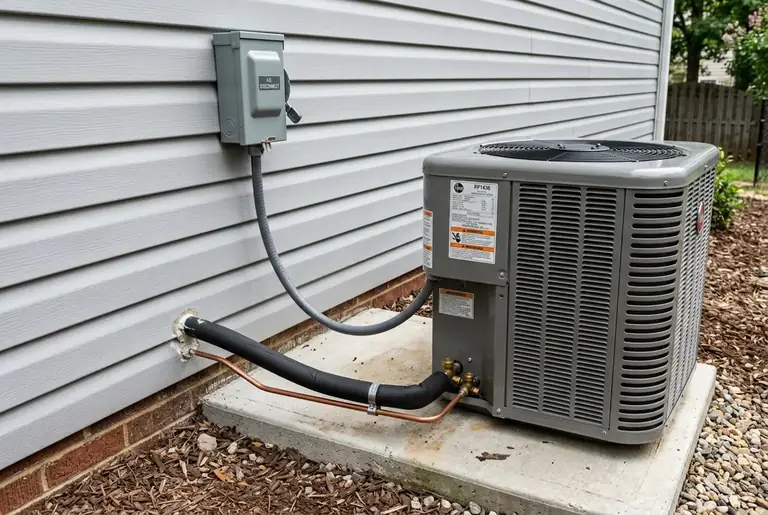
A quality install includes protecting flooring and access paths, proper recovery of old refrigerant, correct line-set treatment or replacement, a deep vacuum before charging, verified charge and airflow at start-up, condensate routing with a working safety switch, and a walkthrough of the thermostat and filter access before the crew leaves.
It also includes documentation: model and serial numbers, warranty registration, permit information, and the measured start-up values. Those records matter for warranty claims, tax credits, and any future service.
Our installation and replacement guides cover cost ranges, what to ask before signing, how to compare quotes on matching scope, and the specific signs that your current system is near the end of its useful life in a Louisiana home.
AC Installation & Replacement FAQs
What homeowners in Kenner, Metairie, New Orleans, and the surrounding parishes ask before replacing a system.
How long does an HVAC system last in Louisiana?
Service life varies with condition, maintenance, and run hours rather than a fixed number of years. Our long cooling season means equipment here accumulates runtime quickly, so condition and repair history matter more than age alone.
How do I know if my AC is the right size?
The symptoms of oversizing are short cycles and a cold-but-clammy house; undersizing shows up as a system that runs constantly and never reaches the setpoint. The only reliable answer comes from a load calculation that accounts for insulation, windows, air leakage, and duct condition.
Should ductwork be replaced with a new system?
Often yes. New equipment is engineered around a specific airflow target, and leaking, undersized, or poorly insulated ducts will prevent it from delivering rated comfort and efficiency. Doing both together also avoids paying twice for access and labor.
How long does a replacement take?
Most single-system residential changeouts are completed in one day. Jobs involving duct replacement, electrical upgrades, or difficult attic and crawl-space access can run two to three days.
What efficiency rating should I choose?
Because runtime is high here, stepping above the minimum efficiency tier usually pays back faster than it would in a milder climate. Beyond a point, though, installation quality and duct condition matter more than the rating on the box — so fix the ducts before buying more SEER2.
Do you handle permits and inspections?
Yes. Replacement work in our service area is permitted and inspected according to the requirements of the parish or municipality, and we handle that as part of the job.
Your Next Steps
Ready for help from a local team? Start here, or call (504) 762-0331.